
Capturing the lightning: single-shot measurement of ultrashort pulses with a-swing
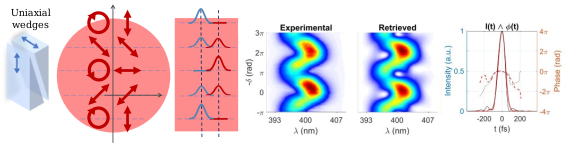
Some phenomena don’t offer second chances. A lightning strike, an explosion, a single laser pulse: they happen in an instant and then vanish. In the world of ultrafast optics, this poses a real challenge. Ultrashort laser pulses —lasting just a few tens of femtoseconds— are so brief and volatile that, in unstable pulse trains, there’s no time to scan slowly or rely on averaging: everything must be captured in a single shot.
To meet this need, a single-shot version of the amplitude swing (a-swing) technique has been implemented, enabling robust and versatile characterization of such pulses. In previous setups, the pulse modulation was achieved by rotating an optical element; in this new implementation, that modulation is transferred into space. In other words, traditional scanning setups gather the pulse trace by stitching together partial traces from many pulses. Here, instead, the full trace can be acquired from a single pulse. It’s like trying to photograph a lightning strike: before, we had to piece together fragments from different flashes. But if each flash is different, the result will be blurry or incoherent. Now, we can capture the entire scene in a single frame.
At the core of this idea is the use of a pair of birefringent wedges, which imprint a spatial modulation on the pulse’s polarization. This is then converted into a relative amplitude modulation via a quarter-wave plate. This spatial modulation replaces mechanical scanning, without adding complexity or sacrificing stability. Each portion of the beam experiences a different modulation, effectively resolving the spectral map across space. This enables the pulse trace to be recorded all at once, instead of being assembled from multiple consecutive pulses. The resulting signal is measured using an imaging spectrometer, which captures the second-harmonic signal generated by the interference of the two pulse replicas.
This setup inherits the benefits of scanning-based a-swing configurations, so it can be applied to pulses with a variety of durations, chirps, and spectral regions and bandwidths, including few-cycle pulses. To reconstruct the full pulse shape, a ptychographic algorithm is employed, now adapted to this new single-shot architecture. This combination yields precise information about the original pulse from its “spectral fingerprint,” even when the pulse is non-repetitive.
This single-shot version of a-swing addresses a real need in experiments where every pulse may be different. In such contexts, having a reliable, compact, and versatile method to “photograph the lightning” isn’t just useful: it’s the difference between watching it pass… or truly capturing it.
More information at:
C. Barbero, Í. J. Sola, and B. Alonso, “Ultrafast single-shot amplitude swing pulse measurement”, J. Phys. Photonics 7, 035028 (2025). https://doi.org/10.1088/2515-7647/adeeef