
Spectral traces: a new ptychographic algorithm to reconstruct ultrashort pulses with amplitude swing
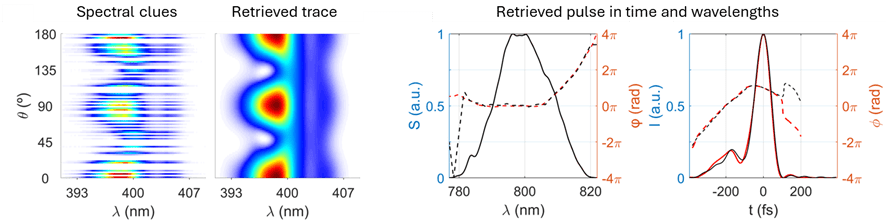
When a light pulse lasts only a few femtoseconds —a millionth of a billionth of a second— understanding its full shape (amplitude, phase, polarization) becomes both a complex and fascinating challenge. These ultrashort pulses are essential for exploring ultrafast phenomena in physics, chemistry, and biology. But capturing them is like solving a crime without witnesses: you can’t observe them directly. You can only register what they leave behind —their trace. Their spectral fingerprint.
A recent technique called amplitude swing (a-swing) allows us to capture that trace. The pulse is split into two replicas with a temporal delay, and their relative amplitude is modulated. The result is a second-harmonic signal whose spectrum contains encoded information about the original pulse. It’s like letting light speak in its own language —a nonlinear spectral one— and recording what it says from different angles.
But understanding that language and reconstructing the full story of the pulse is far from trivial. That’s where a powerful tool comes into play: a ptychographic algorithm that tackles the problem with a strategy inspired by skilled interrogators. Instead of asking one big question —as previous algorithms do— this approach acts like a clever detective: it asks many small, targeted questions, slightly changing the conditions (plate angle, amplitude modulation), and carefully listens to the system’s responses. No single answer is conclusive, but together they paint a coherent picture. As in a good reconstructive interrogation, truth emerges from the intersections.
In this way, the algorithm gradually refines its hypothesis about the pulse —its intensity, phase, and polarization— without needing to assume its shape in advance. It just needs enough spectral clues to piece together the full structure, step by step.
This method has proven to be fast (reducing reconstruction time from minutes to seconds), robust against missing or noisy data, and powerful: it can reconstruct even complex vector pulses with time-varying polarization, double pulses, or abrupt phase features. All using a compact, simple, and versatile experimental setup.
The result is a technique that turns a set of spectral clues into a complete and precise picture of the original pulse. A tool that not only facilitates the characterization of ultrafast light, but also shows how sometimes, the best way to understand the fleeting… is to ask the right questions, one at a time.
More information at:
C. Barbero, Í. J. Sola, and B. Alonso, “Ptychographic retrieval for complete ultrashort pulse amplitude swing reconstruction,” Opt. Laser Technol. 188, 112 939 (2025). https://doi.org/10.1016/j.optlastec.2025.112939